Battle of the Atlantic 1939–41 by Mark Lardas & Edouard A. Groult
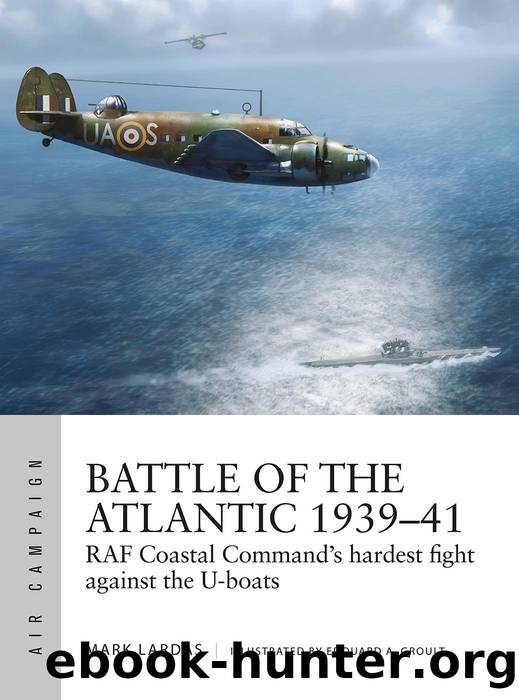
Author:Mark Lardas & Edouard A. Groult
Language: eng
Format: epub
ISBN: 9781472836021
Publisher: Bloomsbury Publishing
Published: 2019-10-25T00:00:00+00:00
The first round: September 1939 to June 1940
The opening of World War II caught both sides unprepared for a new Battle of the Atlantic. Hitler did not believe Britain and France would go to war over Poland, thinking they would back down at the last minute. They had on every previous German land grab, from the remilitarization of the Rhineland in March 1936 through to the occupation of Czechoslovakia in March 1939. Hitlerâs military build-up was incomplete, with the Kriegsmarine only starting the expansion envisioned under the âZâ plan, which envisioned the re-equipping and growth of German naval forces to match the Royal Navy by 1948.
Britain was similarly unprepared. It, too, was only beginning its rearmament. Coastal Command and the FAA were lagging behind other organizations in the build-up. Coastal Commandâs Hudson squadrons were only just becoming available for use. While the Lerwick and Botha were finally coming off the assembly lines, there were no active squadrons flying these. The Anson and every flying boat, except the Sunderland, were unsatisfactory.
As for the FAA, not only were there too few aircraft and aircrew, but available aircraft were inadequate. The torpedo bombers were outdated, and the FAAâs dive bomber (the Skua) and its fighters (Fulmar and Roc) were inferior to similar carrier aircraft of other navies. Although neither Coastal Command nor the FAA yet realized it, they had no effective weapons against U-boats. The 100lb anti-shipping bombs could not crack a U-boatâs hull, the 250lb bomb required a direct hit and only the Sunderland could carry the air-droppable 450lb depth charge.
In August 1939 Dönitz had only 57 U-boats in commission, with four fitting out and 16 under construction. Another 41 were on order. Only 28 commissioned U-boats were ocean-going designs displacing 500 tons or more. Twenty-nine were various Type II 250-ton boats. He sent his boats to sea from 19 August, before the scheduled invasion of Poland, against a potential British declaration of war. He had conducted similar mobilizations prior to previous crises, viewing them as valuable practice if war broke out. This time it did.
Reserving four Type II and three Type VII U-boats for action in the Baltic, Dönitz sent the rest to battle stations in the North Sea and North Atlantic. Three Type II boats were sent to patrol the Kattegat, connecting the Baltic and North Seas between Denmark and Sweden. Thirteen Type IIs were sent into the North Sea, while 19 Type IA, VII and IX U-boats were assigned sectors in the North Atlantic Ocean, covering the south-west and north-west Approaches to the British Isles. A few others were held in port as reserves.
Coastal Command aircraft began patrolling the North Sea and English Channel on 24 August as the two nations began to slide towards war. Their main mission was not hunting U-boats, but rather detecting Kriegsmarine warships exiting the North Sea and tracking German merchant shipping traversing these waters. They had missed the warships, which passed through the aerial cordon before 24 August.
When Germany invaded Poland on 1 September 1939, Britain issued an ultimatum demanding German withdrawal from Poland.
Download
This site does not store any files on its server. We only index and link to content provided by other sites. Please contact the content providers to delete copyright contents if any and email us, we'll remove relevant links or contents immediately.
| Africa | Americas |
| Arctic & Antarctica | Asia |
| Australia & Oceania | Europe |
| Middle East | Russia |
| United States | World |
| Ancient Civilizations | Military |
| Historical Study & Educational Resources |
The Radium Girls by Kate Moore(12180)
100 Deadly Skills by Clint Emerson(5023)
Rise and Kill First by Ronen Bergman(4890)
The Templars by Dan Jones(4794)
The Doomsday Machine by Daniel Ellsberg(4619)
The Rape of Nanking by Iris Chang(4324)
Killing England by Bill O'Reilly(4107)
Stalin by Stephen Kotkin(4061)
Hitler in Los Angeles by Steven J. Ross(4015)
12 Strong by Doug Stanton(3631)
Hitler's Monsters by Eric Kurlander(3456)
The Code Book by Simon Singh(3320)
Blood and Sand by Alex Von Tunzelmann(3299)
Darkest Hour by Anthony McCarten(3222)
The Art of War Visualized by Jessica Hagy(3098)
Hitler's Flying Saucers: A Guide to German Flying Discs of the Second World War by Stevens Henry(2815)
Babylon's Ark by Lawrence Anthony(2780)
Tobruk by Peter Fitzsimons(2619)
The Second World Wars by Victor Davis Hanson(2577)
